


Myeloperoxidase (MPO) Activity Assay Kit
Couldn't load pickup availability

Still have questions? Ask our experts!
Myeloperoxidase (MPO) Activity Assay Kit
| SKU # | E-BC-K074-M |
| Detection Instrument | Microplate reader (450 nm-470 nm, optimum wavelength: 460 nm) |
| Detection Method | Colorimetric method |
Product Details
Properties
| Synonyms |
MPO |
| Sample Type | Animal liver, muscle |
| Sensitivity | 19.42 U/L |
| Detection Range | 19.42-893.31 U/L |
| Detection Method | Colorimetric method |
| Assay type | Enzyme Activity |
| Assay time | 65 min |
| Precision | Average inter-assay CV: 7.300% | Average intra-assay CV: 5.400% |
| Other instruments required | Tubes, Micropipette, Vortex mixer, 37℃/60℃ Water bath |
| Storage | 2-8℃ |
| Valid period | 12 months |
Images
Y J Choi investigate the effective of complement component 3 (C3) deficiency promoting its receptor downstream-mediated inflammatory response. Myeloperoxidase (MPO) activity of mouse colon was determined using MPO activity assay kit (E-BC-K074-M).
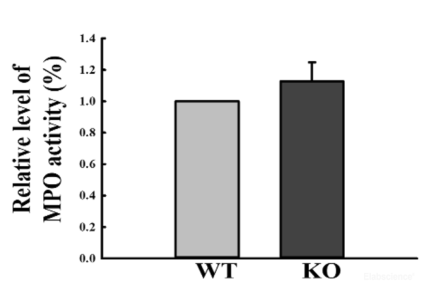
The activity of MPO indicating the neutrophil level was slightly higher in the KO (C3 knockout) than WT (wild type) mice.
Dilution of Sample
It is recommended to take 2~3 samples with expected large difference to do pre-experiment before formal experiment and dilute the sample according to the result of the pre-experiment and the detection range (19.42-893.31 U/L).
The recommended dilution factor for different samples is as follows (for reference only):
| Sample type | Dilution factor |
| Human serum | 1 |
| Human plasma | 1 |
| Human milk | 1 |
| Cell culture supernatant | 1 |
| Rat serum | 1 |
| Rat plasma | 1 |
| 5% Rat kidney tissue homogenate | 1 |
| 5% Rat spleen tissue homogenate | 1 |
Note: The diluent is reagent 2 application solution.
Detection Principle
Myeloperoxidase reduces hydrogen peroxide to a complex. The complex react with o-dianisidine (as hydrogen donor) to produce a yellow product which has a maximum absorption peak at 460 nm. The activity of MPO can be calculated indirectly by measuring the OD value at 460nm.
Kit Components & Storage
| Item | Component | Size 1(48 T) | Size 2(96 T) | Storage |
| Reagent 1 | Buffer Solution | 10 mL ×1 vial | 20 mL × 1 vial | 2-8℃, 12 months |
| Reagent 2 | Powder A | Powder × 1 vial | Powder × 2 vials | 2-8℃, 12 months |
| Reagent 3 | Powder B | Powder × 1 vial | Powder × 2 vials | 2-8℃, 12 months |
| Reagent 4 | Saline Solution | 3 mL ×1 vial | 6 mL × 1 vial | 2-8℃, 12 months |
| Reagent 5 | Clarificant | 1.2 mL ×1 vial | 1.2 mL × 2 vials | 2-8℃, 12 months |
| Reagent 6 | Powder C | Powder × 1 vial | Powder × 2 vials | 2-8℃, 12 months, shading light |
| Reagent 7 | Substrate | 0.1 mL × 1vial | 0.1 mL × 1vial | 2-8℃, 12 months |
| Reagent 8 | Acid Reagent | 1 mL × 1 vial | 1 mL × 1 vial | 2-8℃, 12 months |
| Microplate | 96 wells | No requirement | ||
| Plate Sealer | 2 pieces | |||
Note: The reagents must be stored strictly according to the preservation conditions in the above table. The reagents in different kits cannot be mixed with each other. For a small volume of reagents, please centrifuge before use, so as not to obtain sufficient amount of reagents.
Technical Data:
Parameter:
Intra-assay Precision
Three human serum samples were assayed in replicates of 20 to determine precision within an assay (CV = Coefficient of Variation).
| Parameters | Sample 1 | Sample 2 | Sample 3 |
| Mean (U/L) | 36.50 | 264.50 | 579.60 |
| %CV | 5.8 | 5.4 | 5.0 |
Inter-assay Precision
Three human serum samples were assayed 20 times in duplicate by three operators to determine precision between assays.
| Parameters | Sample 1 | Sample 2 | Sample 3 |
| Mean (U/L) | 36.50 | 264.50 | 579.60 |
| %CV | 7.2 | 7.5 | 7.2 |
Recovery
Take three samples of high concentration, middle concentration and low concentration to test the samples of each concentration for 6 times parallelly to get the average recovery rate of 104%.
| Sample 1 | Sample 2 | Sample 3 | |
| Expected Conc. (U/L) | 95.6 | 342.5 | 678.2 |
| Observed Conc. (U/L) | 95.6 | 363.1 | 718.9 |
| Recovery rate (%) | 100 | 106 | 106 |
Sensitivity
The analytical sensitivity of the assay is 19.42 U/L. This was determined by adding two standard deviations to the mean O.D. obtained when the zero standard was assayed 20 times, and calculating the corresponding concentration.