


Acetylcholinesterase (AchE) Activity Assay Kit
Couldn't load pickup availability

Consumables Product
This consumable product is not available for refund or return

Still have questions? Ask our experts!
Acetylcholinesterase (AchE) Activity Assay Kit
| SKU # | E-BC-K174-M |
| Detection Instrument | Microplate reader (optimum wavelength: 412 nm) |
| Detection method | Colorimetric method |
Product Details
Properties
| Synonyms |
AchE |
| Sample Type | Serum, plasma, animal tissue and cell |
| Sensitivity | 1.225 U/mL |
| Detection Range | 1.225-490 U/mL |
| Detection Method | Colorimetric method |
| Assay type | Enzyme Activity |
| Assay time | 20 min |
| Precision | Average inter-assay CV: 9.300% | Average intra-assay CV: 4.700% |
| Other instruments required | Micropipettor, Incubator, Vortex mixer, Centrifuge |
| Other reagents required | Normal saline (0.9% NaCl), PBS (0.01 M, pH 7.4) |
| Storage | 2-8℃ |
| Valid period | 12 months |
Images
A F Odetayo et al investigate the effect of bisphenol F on sexual performance and quality. Acetylcholinesterase (AchE) activity of rat plasma was determined using AchE activity assay kit (E-BC-K174-M).
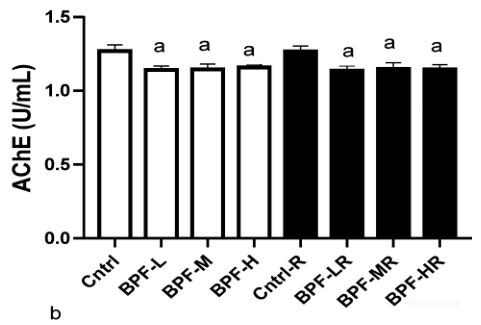
The activity of AchE was significantly decreased comparing with control groups. (P<0.05 versus age-matched control)
Dilution of Sample
It is recommended to take 2~3 samples with expected large difference to do pre-experiment before formal experiment and dilute the sample according to the result of the pre-experiment and the detection range (13.88-320.13 U/mL).
The recommended dilution factor for different samples is as follows (for reference only):
| Sample type | Dilution factor |
| Mouse serum | 8-20 |
| Mouse plasma | 4-10 |
| Human serum | 4-10 |
| Human plasma | 4-10 |
| Rat serum | 4-10 |
| Dog serum | 4-10 |
| Horse serum | 2-8 |
| 10% Mouse liver tissue homogenate | 1 |
| 10% Mouse kidney tissue homogenate | 1 |
| 10% Mouse brain tissue homogenate | 2-8 |
| 10% Crucian carp muscle tissue homogenate | 1 |
Note: The diluent is normal saline (0.9% NaCl) or PBS (0.01 M, pH 7.4).
Detection Principle
AchE catalyzes the hydrolysis of acetylcholine to form choline, and choline react with dithio p-nitrobenzoic acid (DTNB) to form 5-mercapto-nitrobenzoic acid (TNB). TNB has an absorption peak at 412nm. And the activity of AchE is calculated by measuring the increasing rate of absorbance at 412nm.
Kit Components & Storage
| Item | Component | Size 1(48 T) | Size 2(96 T) | Storage |
| Reagent 1 | Lysis Buffer | 50 mL × 1 vial | 50 mL × 2 vials | 2-8°C, 12 months |
| Reagent 2 | Buffer Solution | 15 mL × 1 vial | 30 mL × 1 vial | 2-8°C, 12 months |
| Reagent 3 | Chromogenic Agent | Powder × 1 vial | Powder × 1 vial | 2-8°C, 12 months, shading light |
| Reagent 4 | Substrate | Powder × 1 vial | Powder × 1 vial | 2-8°C, 12 months, shading light |
| Microplate | 96 wells | No requirement | ||
| Plate Sealer | 2 pieces | |||
Note: The reagents must be stored strictly according to the preservation conditions in the above table. The reagents in different kits cannot be mixed with each other. For a small volume of reagents, please centrifuge before use, so as not to obtain sufficient amount of reagents.
Technical Data:
Parameter:
Intra-assay Precision
Three human serum samples were assayed in replicates of 20 to determine precision within an assay. (CV = Coefficient of Variation)
| Parameters | Sample 1 | Sample 2 | Sample 3 |
| Mean (U/mL) | 10.20 | 88.50 | 264.00 |
| %CV | 5.2 | 4.6 | 4.3 |
Inter-assay Precision
Three human serum samples were assayed 20 times in duplicate by three operators to determine precision between assays.
| Parameters | Sample 1 | Sample 2 | Sample 3 |
| Mean (μg/mL) | 10.20 | 88.50 | 264.00 |
| %CV | 9.1 | 9.3 | 9.5 |
Recovery
Take three samples of high concentration, middle concentration and low concentration to test the samples of each concentration for 6 times parallelly to get the average recovery rate of 104%.
| Standard 1 | Standard 2 | Standard 3 | |
| Expected Conc. (U/mL) | 138.5 | 252 | 381.3 |
| Observed Conc. (U/mL) | 146.8 | 257.0 | 396.6 |
| Recovery rate (%) | 106 | 102 | 104 |
Sensitivity
The analytical sensitivity of the assay is 1.225 U/mL. This was determined by adding two standard deviations to the mean O.D. obtained when the zero standard was assayed 20 times, and calculating the corresponding concentration.